Opinion
Spotify Wrapped: Data Collection Wrapped in Consumption Perversion
How Spotify Wrapped transforms consumption into identity, why the music streaming model is broken, and my attempt to refuse it all.
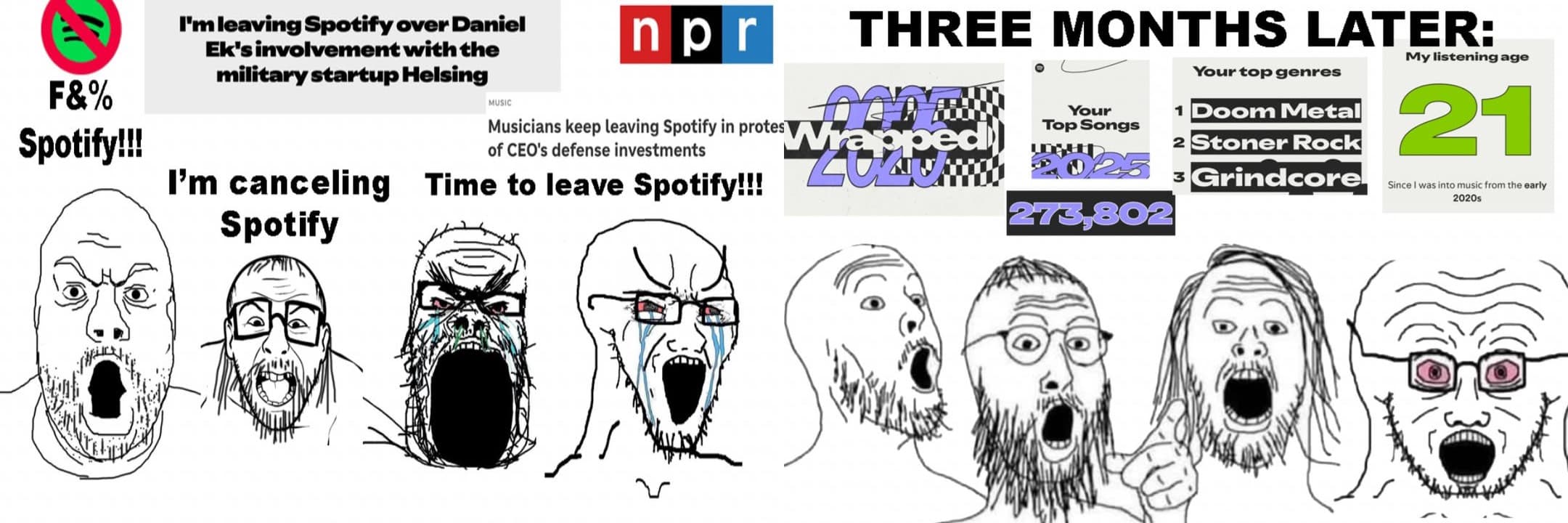
@doomscroll_forever on Instagram
Having access to nearly every piece of published music at any given time is a serious consumer luxury. It’s also fairly well known that the platforms providing this luxury, especially Spotify, do so while paying artists poorly. This has led to years of public pressure, boycotts, and calls to switch to more “ethical” alternatives like Tidal.
That discourse doesn’t interest me much.
What does interest me is how Spotify has survived all of that pressure not just intact, but stronger than ever. In an era defined by stan culture, infinite sub-genre fragmentation, and people selling screenshots of low monthly listener counts as proof of cultural foresight, it’s hard to believe users simply don’t care. Something else is clearly working.
For me, that something was Spotify Wrapped.
I switched off Spotify in January of this year. Before that, I suspect Wrapped alone kept me on the platform for at least my last two years — which is embarrassing to admit. I was tracking my listening with last.fm before Wrapped even existed, so maybe I deserve some grace. Still, the mechanism is the same.
Beyond Artist Payouts
Every December now, tech platforms roll out their year-in-review products. Spotify, Strava, Duolingo, DoorDash, Discord, ChatGPT — all offering some variation of the same thing: fun facts and personal insights generated from the massive amounts of data they collect.
The transparency is disarming. Look how much we know about you! Nothing is wrong with this, it says — it’s just for you.
But this is where things move from the technical, into a more metaphysical conversation.
Capitalism is always looking for new frontiers. The current frontier isn’t just our relationship with products anymore — it’s our relationship with consumption itself. If platforms can convince us to identify with what we consume, then consumption becomes identity. And once that happens, the system no longer needs to persuade us. We persuade ourselves.
That’s manufacturing consent.
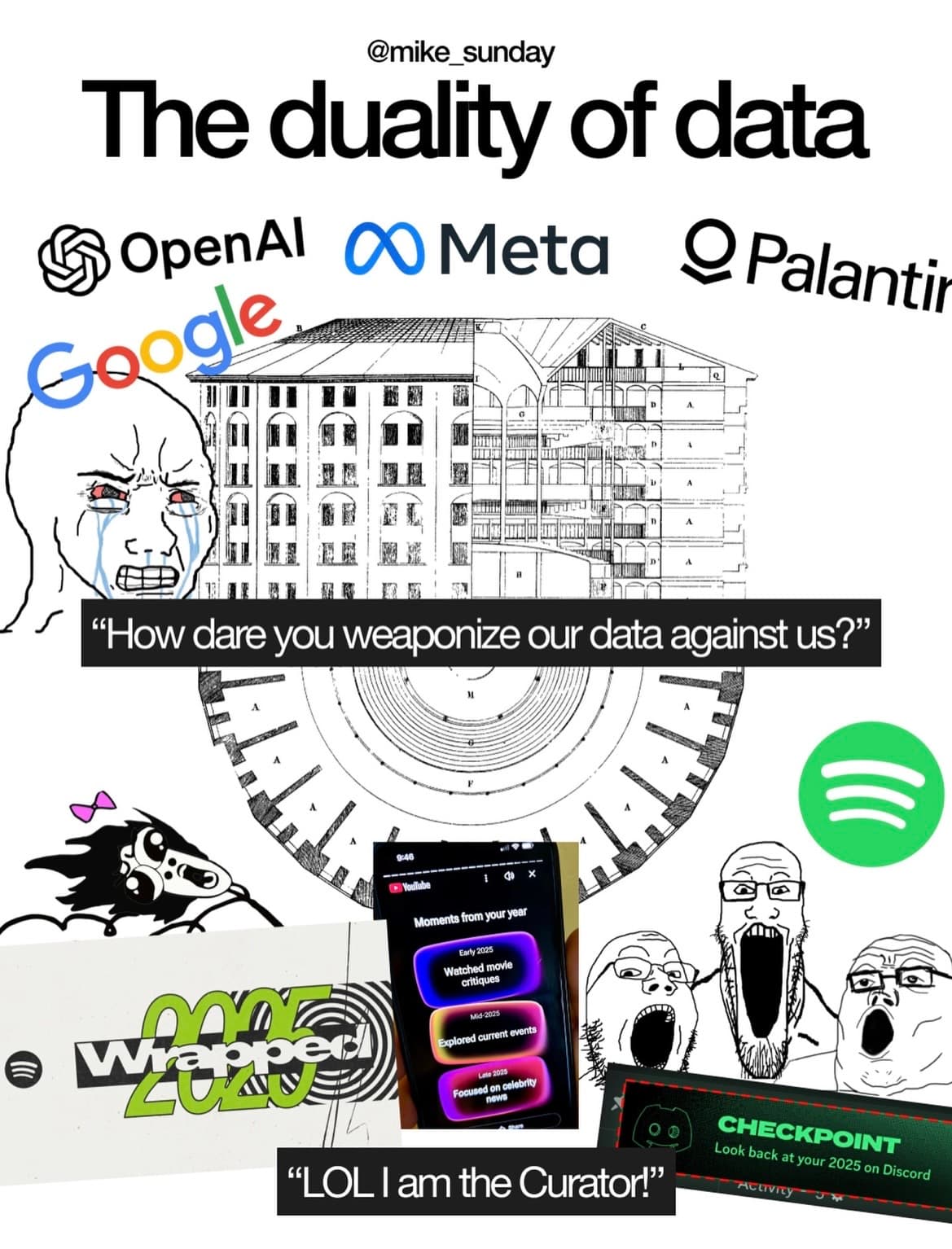
@mike_sunday on Instagram
When Metrics Stop Measuring
I see this taking root already. I see it as a set of symptoms in contemporary youth culture — and while I don’t have hard data, I’ll speak from intuition and experience.
Instagram shows you who liked what. Who followed whom. Who unfollowed. People call this “gamification,” but that framing misses something crucial. Gamification assumes abstraction — points, levels, rewards. What’s happening now is more intimate.
Once you know your year will be summarized, your behavior stops being neutral.
Wrapped turns ordinary usage into anticipatory performance.
People start behaving for the recap. The metric becomes the story. And once that happens, the metric no longer measures genuine behavior — it measures optimization.
On Spotify this looks like replaying certain artists for social recognition at the end of the year. I’ve caught myself doing similar things elsewhere: liking or not liking posts because I know others will see, following or unfollowing accounts based on how it reads publicly. The Duolingo streak works the same way — people grind out meaningless lessons just to preserve a number, completely detached from the supposed goal of learning a language.
This isn’t isolated. I’ve heard people casually reference who liked whose post, who unfollowed whom, as if this information should be legible at all. People should not know these things about one another. The social consequences are enormous, but that’s a different essay.
The point here is scope. These effects ripple outward.
Consumption as Identity
Now bringing it back inward — people are increasingly identifying with what they consume.
Take the Stanley cup craze. Now imagine if Target released a year-in-review built from purchase data they absolutely already have. If “you were in the top 0.1% of Stanley buyers” was normalized, that moment would have been far more intense. Artificial scarcity plus resale culture would’ve compounded into something even uglier.
And it’s already happening elsewhere.
People sell screenshots of artists with low monthly listener counts — proof of early adoption, cultural foresight converted into tradeable clout. Attention becomes an asset. Consumption becomes speculation. There’s a straight line from this to betting markets, to influencer coins, to speculative fandom. Niche for niche.
Information becomes currency. Identity becomes a portfolio.
Posting Wrapped isn’t neutral. It asks your social circle to update their perception of you accordingly. Comparison follows naturally. Herd effects take over. People converge on artists, restaurants, habits — not because they resonate, but because they perform well on the scoreboard.
All without ever issuing instructions.
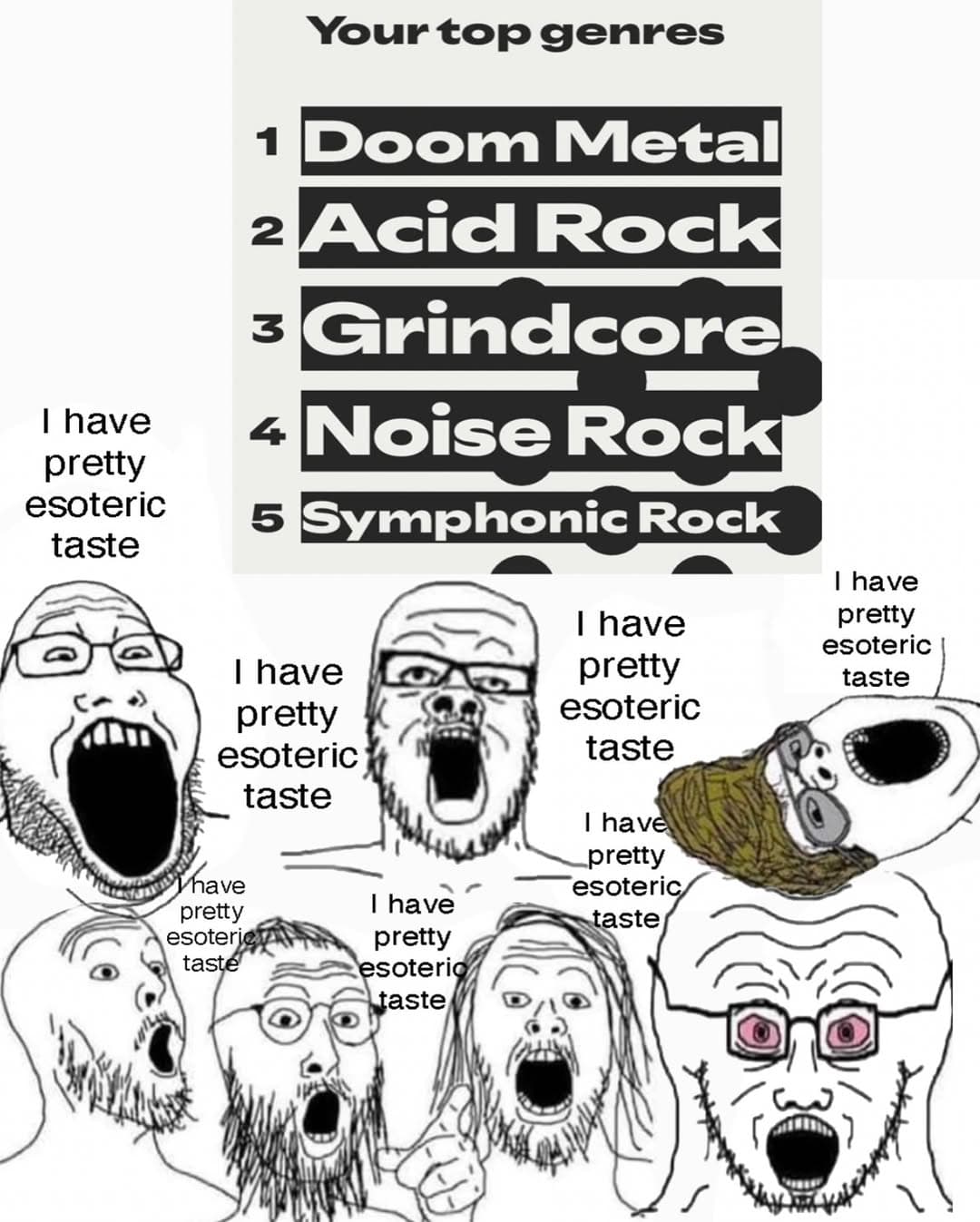
@doomscroll_forever on Instagram
On Artists, Platforms, and Where I Stand
Despite saying I don’t care much for payout discourse, it matters to my own decisions, so I’ll be direct.
I don’t fully agree with the dominant narrative around artist compensation. Yes, it’s absurd how much music we access for so little. But moralizing consumption through guilt strikes me as misplaced — and often entitled. Most artists would not have fared better under legacy models. Radio, MTV, physical sales — all gatekept and exclusionary.
Today, access is broader. Artists reach global audiences. Independent scenes thrive. Merch sells. Shows sell out. Artists are still being screwed — but the system offers more opportunity than before, not less.
That doesn’t mean the current model is acceptable.
Major labels lost control only for artists to become dependent on streaming platforms instead — new gatekeepers, new daddies. Cutting out tech overlords matters. I don’t have a clean solution yet, but I know the direction.
My decision to leave Spotify wasn’t just economic. It was political.
Spotify’s investments tied to AI drone warfare, YouTube’s advertising relationships during an ongoing genocide — these companies make their values clear. They extract data, monetize attention, and pervert our relationship with art. At some point, you draw a line.
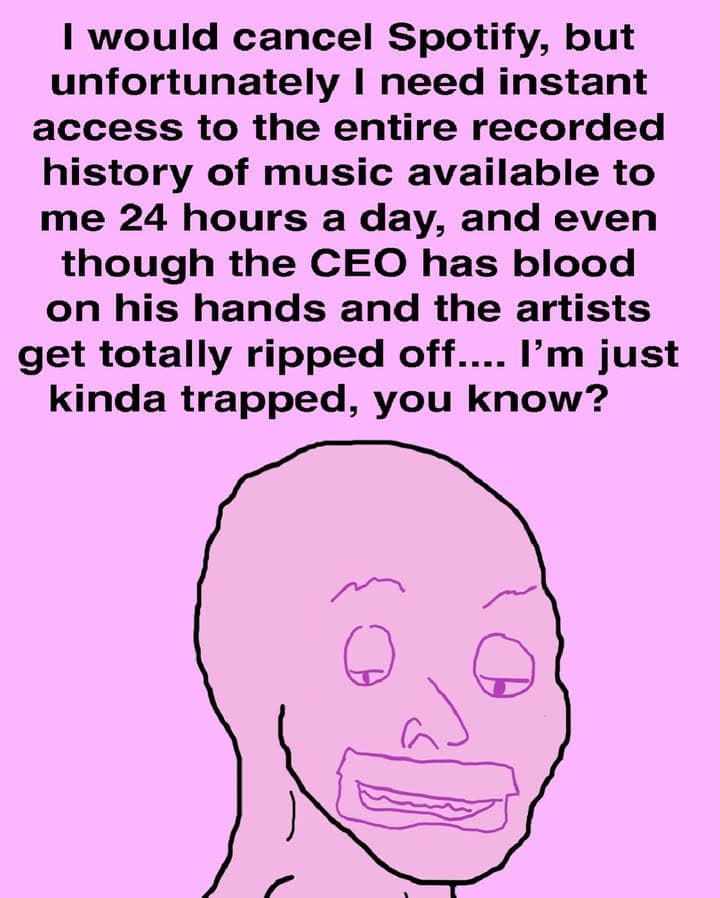
@doomscroll_forever on Instagram
How I’m Refusing
This blog is part of that refusal.
It’s anti–big tech and anti–social media — not anti-internet, not anti-technology. I’m a socialist and a software engineer. I believe the internet could be one of the most liberatory tools ever built if freed from profit incentives and infinite growth narratives.
I don’t accept surveillance as convenience.
I don’t accept platforms as inevitable.
I want to write slowly. Deliberately. About music I actually like — not what an algorithm surfaces. I’ll defend software from lazy critiques and critique power where it actually sits. I’ll think out loud about culture because I live in it and will inherit its consequences.
Practically, I’m working my way off streaming. I dropped Spotify at the beginning of this year for YouTube Music, and now switching to SoundCloud Go+. I’m rebuilding a library through Bandcamp and direct purchases, supplementing where necessary. Piracy remains on the table for corporations that profit from good art. Thom Yorke, I’m looking at you.
Pay-what-you-want models matter. Ownership matters. A mixed ecosystem — streaming where least harmful, direct support where possible — feels like the next step forward.
Final Thoughts and Going Forward
Wrapped works because the incentives work — for Spotify.
It increases engagement, reduces churn, and generates free advertising every December. It turns time spent into sunk psychological cost. Quitting feels like erasing a personal archive.
For everyone else, it turns ordinary behavior into performance. The recap defines what is legible, and people naturally steer toward legibility. Economically, it creates the perfect user: predictable, loyal, easy to model.
So instead of posting a Wrapped, I did my own version. I wrote about the artists and albums that mattered to me. Not ranked. Not scored. Not optimized.
I don’t want my year summarized by a corporation.
I don’t want my inner life rendered into slides.
I don’t want to behave today for the sake of an infographic tomorrow.
This isn’t about purity.
It’s about refusing control.
It’s still important to choose, in small ways, not to let everything be conquered, measured, and sold back to me.
drowning in distortion
MAILING LIST
VIEW ON SUBSTACK →Subscribe to the newsletter
Get notified when new posts are published. No spam, no noise. Just signal delivered straight to your inbox.
Powered by Substack. Unsubscribe anytime.